
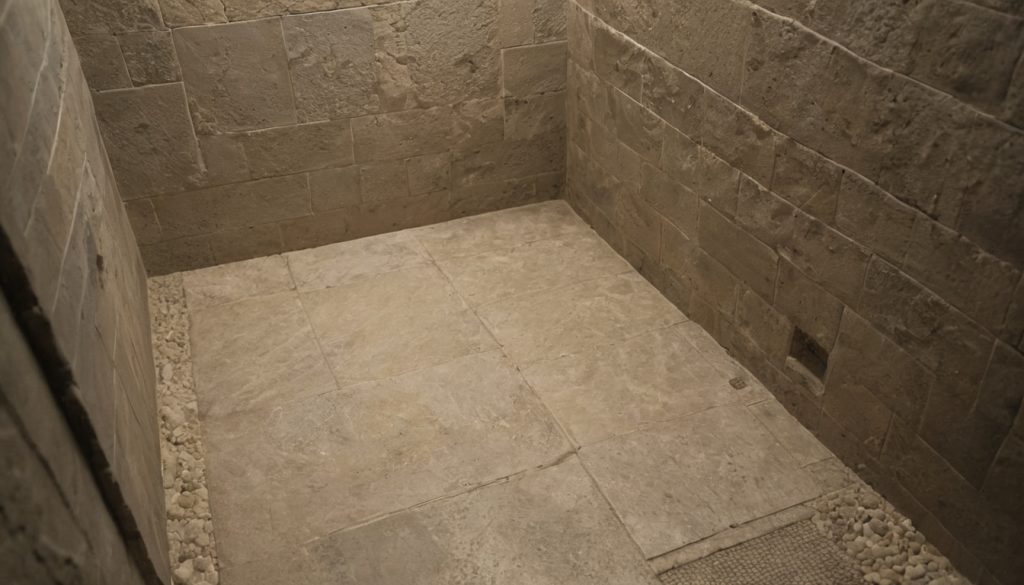
Has a newly installed honed limestone threshold developed a dark band climbing from the shower-side edge? If the stone darkens during use and returns to its documented dry color, absorption may be normal; persistent, spreading, joint-led, or no-use discoloration requires a traced moisture source before anyone approves cleaning, sealing, or reconstruction.
Is a dark limestone shower threshold normal wetting or a construction defect?
A repeatable wet-and-dry cycle can indicate ordinary stone absorption. Darkening that remains after a controlled drying period, migrates beyond the wetted area, or follows joints and penetrations suggests retained moisture or another source requiring investigation.
A repeatable wet-and-dry color cycle indicates absorption, not automatically failure
Acceptance requires comparison with an approved dry baseline, not a showroom photograph. Identify the quarry, commercial stone name, finish, thickness, production batch, threshold configuration, and corresponding ASTM C97/C97M absorption result. Record whether the stone is a curb cap, recessed transition, or barrier-free entry.
- Photograph the dry threshold beside a known dry control.
- Apply a recorded water volume or exposure period.
- Photograph the stone immediately and at fixed drying intervals.
- Record temperature, relative humidity, ventilation, and time since previous shower use.
| Observed pattern | Initial interpretation |
|---|---|
| Uniform darkening that clears | Consistent with temporary absorption if the stone returns to its approved baseline. |
| Darkening centered on a joint | Check grout, sealant, movement joints, and the assembly below. |
| Dark band rising from an inside edge | Investigate edge entry, poor pitch, or retained moisture beneath the cap. |
| Marks around penetrations | Inspect drilled fixings and their waterproofing treatment. |
| Discoloration beyond the receptor | Treat it as moisture migration until testing identifies another source. |
Persistent or spreading darkening indicates retained moisture that needs a traced source
Map comparative readings across the threshold, curb faces, bathroom floor, adjacent finishes, and a dry control. Repeat observations during a no-use period and isolate plumbing where supply or waste leakage remains plausible. Coastal humidity may slow drying when recorded conditions support that conclusion. Salt air alone does not identify a moisture path.
If cleaner or sealer trials release volatile organic compounds, the U.S. Environmental Protection Agency recommends increased ventilation during product use. The next question is whether drainage or waterproofing is keeping the threshold wet.
Is a dark limestone shower threshold normal wetting or a construction defect shown with transport, entry, and visitor-movement context.
Drainage and waterproofing defects can keep a limestone threshold dark
A threshold stays wet when water reaches it faster than the shower assembly can drain or dry. Flat or outward pitch, low points, sealant dams, blocked drainage routes, penetrations, and discontinuous membrane transitions are common paths.
The limestone threshold must direct surface water back into the shower receptor
Record the jurisdiction, permit date, occupancy classification, adopted code edition, and local amendments before judging compliance. Code applicability changes by place and date. California identifies building, residential, and plumbing requirements in separate Title 24 parts. Illinois advises that residential repairs may fall under the local authority having jurisdiction. A generic code quotation is not a project requirement.
Drainage and waterproofing defects can keep a limestone threshold dark shown as a destination-specific travel planning reference.
| Condition | Field check | Evidence required |
|---|---|---|
| Threshold pitch | Measure several cross-sections with calibrated equipment. Mark reverse pitch, flat areas, and lippage. | As-built elevations, approved detail, adopted code, and applicable ANSI provision. |
| Receptor drainage | Map slope, low points, perimeter ponding, and sealant dams. | Approved drawings, drain elevations, and selected TCNA method. |
| Membrane transitions | Trace continuity across the receptor, curb, jambs, corners, and bathroom-side edge. | Shop drawings, installation photographs, and membrane instructions. |
| Penetrations | Locate glass channels, anchors, door hardware, and drilled fixings. | Coordination drawings and records of waterproofing treatment. |
| Concealed drainage | Check manufacturer-defined weep paths or drainage features where included. | Drain details, product instructions, and installation records. |
Waterproofing continuity matters more than the visible stone joint
Limestone, grout, and exposed sealant are finish components, not the primary water-management assembly. The TCNA Handbook contains numbered, condition-specific installation methods for ceramic, glass, and stone tile, including wet areas. Require the handbook edition, exact receptor method, cited ANSI A108 provisions, prepared substrate, and manufacturer-specific system. A method number without its components proves little.
A passed flood test does not confirm every finished threshold detail
A flood-test record confirms only the boundary and construction stage tested. Check its date, duration, water level, witness, and test limit against later threshold setting, glass installation, drilling, stone replacement, and sealant work. Later penetrations or altered transitions may create paths the original test never assessed. If drainage and waterproofing check out, investigate product compatibility.
Limestone, mortar, grout, and sealer specifications can explain the darkening pattern
Pore structure, finish, thickness, backing, mortar, grout, and applied treatments affect how limestone wets and dries. Product names and technical data are required. “Natural stone sealer” is not a specification.
| Material risk | Evidence required | Diagnostic value |
|---|---|---|
| Stone variability | Quarry, supplied lot, finish, thickness, backing, factory treatment, and ASTM C97/C97M report | Tests whether installed stone behaves like the approved control. |
| Setting assembly | Exact membrane, primer, mortar, grout, sealant, cleaner, bed thickness, mixing, and cure records | Tests whether shadows follow coverage, excess thickness, early wetting, or incompatibility. |
| Applied treatment | Sealer or enhancer, coats, application rate, cure conditions, wet-area approval, and maintenance history | Tests whether treatment changed uptake, drying, or color. |
Stone absorption data must match the installed limestone rather than a showroom sample
Require supplier documentation linking ASTM C97/C97M results to the quarry, variety, and supplied lot. Compare the installed threshold and control sample under the same exposure, temperature, humidity, ventilation, and photographic intervals. Generic data for a similarly named limestone is weak evidence.
Setting materials can create temporary or persistent moisture shadows
Record setting, grouting, sealing, flood testing, commissioning, and first-use dates. Compare those intervals with current manufacturer instructions. Installation photographs or controlled removal should establish mortar coverage, bed consistency, backing, and substrate condition.
Limestone, mortar, grout, and sealer specifications can explain the darkening pattern shown with transport, entry, and visitor-movement context.
A sealer may change water uptake without correcting drainage or waterproofing
A penetrating sealer is not shower waterproofing unless its manufacturer expressly approves that use. Test proposed treatments on a representative mock-up. Avoid abrasive powders and creams because the Natural Stone Institute warns that abrasives can scratch natural stone. Product records should be complete before destructive work begins.
A controlled site investigation should precede destructive threshold repairs
The investigation should progress from records and observation to moisture mapping, isolated water tests, and only then selective opening. Random demolition can erase the original path or create another leak.
Moisture readings should be mapped comparatively rather than treated as absolute proof
- Establish a baseline. Stop shower use and cleaning for an appropriate period. Record recent use, temperature, relative humidity, and ventilation.
- Document the instrument. Record its manufacturer, model, mode, calibration status, and stated measurement depth. Limestone composition, salts, metal, and concealed moisture can affect readings.
- Map repeatable points. Tie a grid to photographs or a dimensioned sketch, include dry controls, and repeat readings at fixed intervals. The EPA moisture guide supports prompt correction of persistent damp conditions, not conclusions from one meter reading.
Controlled water tests should isolate one possible path at a time
- Protect cabinetry, timber, metalwork, electrical fittings, and occupied rooms below. Define boundaries and stop conditions.
- Test threshold wetting, shower spray, drain operation, enclosure joints, and plumbing separately where relevant.
- Record photographs and comparative readings before and after each stage. Obtain written approval before dye testing, membrane probing, or stone removal.
The resulting evidence should determine whether cleaning, resealing, or reconstruction is justified.
Approve cleaning, resealing, or reconstruction only when the failure mechanism is demonstrated
Cleaning suits identified removable deposits. Resealing is defensible only after the assembly is sound and manufacturer drying requirements are met. Reverse slope, blocked drainage, plumbing leakage, and membrane discontinuity require assembly repair.
Surface deposits require identification before the limestone is cleaned
Record deposit location, color, texture, solubility, and recurrence. For orange marks, investigate water chemistry and nearby metals. Use a calcitic-stone-compatible test patch and reject unapproved acids. The Natural Stone Institute recommends neutral cleaners, stone soap, or mild liquid dishwashing detergent with warm water.

Approve cleaning, resealing, or reconstruction only when the failure mechanism is demonstrated shown with relevant destination, access, and visitor conditions.
| Demonstrated cause | Appropriate response | Required retest |
|---|---|---|
| Temporary absorption | Observe and document | Controlled wet-and-dry cycle |
| Construction moisture | Allow controlled drying | Comparative moisture map |
| Surface deposit | Approved test-patch cleaning | Check for recurrence |
| Reverse slope or blocked drainage | Correct or rebuild | Elevation and flow test |
| Enclosure or plumbing leakage | Repair the identified path | Repeat isolated test |
| Membrane discontinuity | Reconstruct the affected assembly | Inspection and specified flood test |
Reconstruction requires a defined waterproofing tie-in and retest
Approval requires drawings defining demolition limits and membrane tie-ins, written product compatibility, replacement-stone approval, cure periods, inspection points, retesting, finish protection, and warranty responsibility. Unresolved disputes belong with an independent stone consultant, manufacturer representative, or qualified testing agency.
Better bathroom remodel designs specify the threshold as an assembly, not a stone sample
Reliable bathroom remodel designs coordinate stone with receptor geometry, waterproofing, setting materials, enclosure fixings, ventilation, testing, and maintenance. A finish schedule listing only limestone and sealer leaves the consequential work undefined.
The threshold mock-up should show both dry and wetted limestone
- Use production stone from the intended lot and record its source, finish, backing, thickness, and ASTM C97/C97M data.
- Install the specified membrane interface, mortar, grout, sealant, cleaner, and sealer.
- Photograph accepted dry, wetted, and dried appearances under agreed lighting at fixed intervals.
Finish schedules should include installation and testing responsibilities
The drawings, specifications, and site duties for interior design services should assign these requirements:
- Define threshold dimensions, inward pitch, edges, joints, drain relationship, and enclosure position.
- Name the warranted waterproofing system and applicable TCNA assembly.
- Coordinate penetrations before waterproofing and prohibit unreviewed curb drilling.
- Assign submittals, inspections, flood testing, drying, sealing, wetting tests, warranties, and closeout records.
- Resolve substitutions and drawing discrepancies before installation.
Light or dark stone remains an appearance choice. Neither color substitutes for a coordinated, tested threshold assembly.
Frequently asked questions
How long should a wet limestone shower threshold take to return to its dry color?
No universal drying time applies. Stone porosity, thickness, finish, mortar, sealer, ventilation, temperature, humidity, and exposure affect the result. Establish acceptance through repeated testing against a dry control under recorded conditions.
Does choosing light or dark shower tile make moisture discoloration easier to diagnose or maintain?
Color changes visibility, not the moisture path. Darkening may be more obvious on pale limestone, while deposits may show more readily on dark material. Maintenance decisions should follow tested stone performance and the completed assembly.
What can cause orange discoloration, and should it be cleaned before leak testing?
Possible causes include iron-bearing deposits, corrosion from nearby metal, water chemistry, or transferred construction contamination. Document and identify the mark before cleaning because premature treatment can remove useful evidence or alter the test area.
Can a penetrating sealer stop a limestone shower threshold from darkening?
A compatible sealer may reduce water uptake or change drying behavior. It will not correct reverse pitch, blocked drainage, plumbing leakage, penetrations, or discontinuous waterproofing.
How can discoloration be repaired without concealing a drainage or waterproofing defect?
Demonstrate the cause first through records, comparative moisture mapping, controlled water tests, and selective opening where necessary. Match the repair to that cause, then retest the drainage or waterproofing assembly before approving cosmetic treatment.